
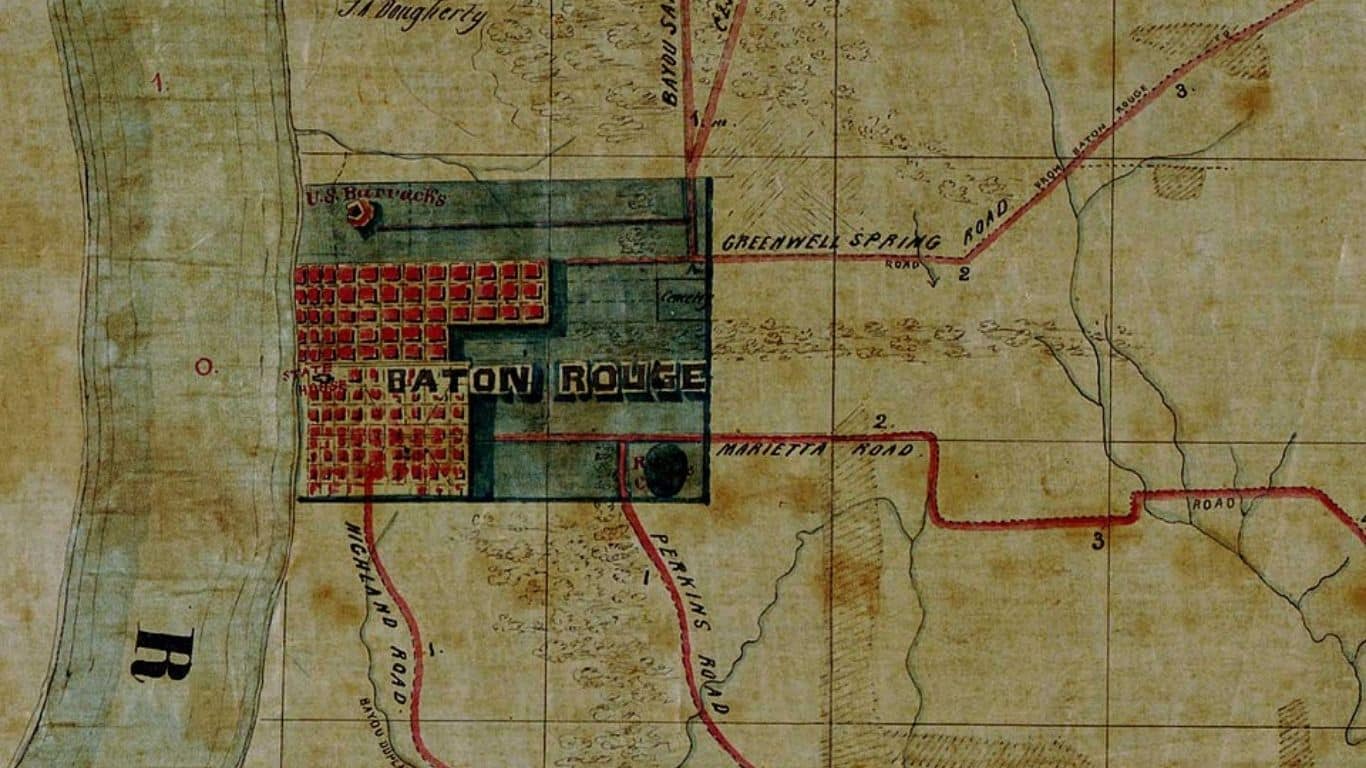
Fort Baton Rouge was a strategic military site established in 1764 on the east bank of the Mississippi River.
Over its active years, it changed hands multiple times, reflecting the region’s complex colonial and early American history.
It was initially a British fort, later controlled by the Spanish, and eventually taken over by American forces before being abandoned in 1819.
The fort played a key role during the American Revolutionary War, most notably when Spanish forces captured it from the British in 1779, denying British control of the Mississippi River.
Its evolving structure and names, such as Fort San Carlos and Fort Richmond, show how the fort adapted to the needs of its successive rulers.
Origins and Construction of Fort Baton Rouge
Fort Baton Rouge was created to replace an earlier fortification that proved vulnerable to artillery.
Its construction marked a strategic effort to secure control over the Mississippi River and defend British interests in the region.
The fort’s location, design, and connections to nearby forts established its importance in colonial military strategy.
Strategic Location on the Mississippi River
Fort Baton Rouge was built on the east bank of the Mississippi River, in what is now Baton Rouge, Louisiana.
This site was chosen for its commanding view of river traffic and control over a key transportation and trade route.
The river pathway was crucial for moving troops and supplies, making the fort’s position vital for British and later Spanish military operations.
The location also provided a natural defensive advantage.
It stood across from the Old River Road, enabling monitoring of movement and securing the surrounding settlements.
Control of this site meant influence over commerce and military movement in the region, particularly during the volatile period of the American Revolutionary War.
Design and Defensive Features
The fort, completed in 1779 and initially called Fort New Richmond by the British, was constructed with earthen walls and surrounded by a ditch eighteen feet wide and nine feet deep.
This ditch served to impede enemy advances.
It incorporated palisades arranged as chevaux de frise, spiked wooden barriers designed to slow infantry assaults.
The fort’s artillery consisted of thirteen cannons, strategically placed to guard approaches from the river and land.
It housed about 400 British troops, including grenadiers and Loyalist militia, emphasizing its role as a well-armed garrison.
The fort replaced Fort Bute, which was deemed indefensible against cannon fire.
Its improved fortifications demonstrated British adaptation to increasing threats and new military technologies.
Relationship to Surrounding Forts
Fort Baton Rouge was part of a network of forts that secured the Mississippi River corridor.
Fort Bute, built in 1765, was an earlier British outpost nearby but lacked adequate defenses against artillery, prompting the construction of Fort New Richmond.
After its capture by Spanish forces under Bernardo de Gálvez in 1779, the fort was renamed Fort San Carlos and integrated into Spain’s defensive strategy in West Florida.
Spanish control of the fort coincided with their broader campaign to oust British forces from the region.
This network also included the Baton Rouge Arsenal and other facilities established later by the U.S. Army.
Fort Baton Rouge’s role evolved as political control shifted, but its connection to surrounding forts was key in controlling regional military and trade routes.
Colonial and Revolutionary War Era
Fort Baton Rouge was a strategic military site that shifted hands between colonial powers before becoming a key battleground in the American Revolutionary War.
Its control influenced the political dynamics in the lower Mississippi region and shaped the wider conflict involving Britain, Spain, and emerging American forces.
French and British Control
Originally part of French Louisiana, Baton Rouge came under British control in 1764 following the Treaty of Paris, which ended the French and Indian War.
The British established Fort Baton Rouge, also called Fort New Richmond, to secure their hold on the strategically important Mississippi River corridor.
The fort served as a defensive outpost within British West Florida, guarding against French or Spanish incursions.
This period lasted until 1779, during which the fort became a key military installation reflecting changing alliances and colonial ambitions in the region.
Role in the American Revolution
Although Louisiana was not yet part of the United States, the fort’s control was vital to the broader revolutionary conflict.
Spain secretly prepared to challenge British dominance in West Florida while maintaining a defensive posture in New Orleans.
Spanish governor Bernardo de Gálvez built up militia forces and intelligence networks, anticipating war with Britain.
His aim was to disrupt British control along the Mississippi and support the American fight for independence indirectly by cutting British supply and communication lines.
The Battle of Baton Rouge (1779)
On September 21, 1779, Gálvez led a combined force of Spanish regulars, militia, free men of color, Native American allies, and American volunteers against the British garrison at Fort Baton Rouge.
The fort was heavily fortified and manned by around 400 British troops with additional armed settlers.
Using diversion tactics and artillery positioned out of sight, Gálvez forced the British into surrender after a brief siege.
This victory ended British control of lower Mississippi forts, including Fort Panmure at Natchez, and secured Spanish dominance in the region.
The capture of Fort Baton Rouge was a decisive moment in the Gulf Coast campaign, contributing to Spain’s broader effort to reclaim West Florida and, indirectly, to the American Revolution by weakening British power.
Spanish Republic and Early U.S. Period
Fort Baton Rouge underwent significant changes during its Spanish administration, the brief independence of the West Florida Republic, and its eventual transition to U.S. control.
Each phase influenced the fort’s identity and strategic importance in Louisiana.
Spanish Administration and Fort San Carlos
After capturing the British fort in 1779, Spanish forces renamed it Fort San Carlos.
This occurred during the American Revolutionary War, under General Bernardo de Gálvez, who led a force that wrested control from the British.
The fort served as a key military post under Spanish rule, positioned strategically near the Mississippi River.
The Spanish administration maintained control over the area for over three decades.
The garrison included free Black and Native American soldiers who played crucial roles during its defense.
Fort San Carlos protected against British incursions, helped stabilize the region, and reinforced Spain’s claim to Louisiana.
Rebellion and the West Florida Republic
In September 1810, inhabitants of the Baton Rouge area, primarily American and remaining British settlers, rebelled against the Spanish authorities by seizing Fort San Carlos.
This uprising led to the formation of the Republic of West Florida, an independent state that lasted approximately three months.
During this short period, the rebels flew their Bonnie Blue Flag over the fort and renamed the site Fort Baton Rouge.
The republic claimed sovereignty over a territory that included parts of present-day Louisiana.
However, the West Florida Republic soon petitioned the United States for annexation.
Transition to U.S. Control
By December 1810, the Republic of West Florida surrendered Baton Rouge peacefully to U.S. forces.
The U.S. government formally annexed the territory, incorporating it into Louisiana.
Fort Baton Rouge then became the westernmost U.S. military post.
Recognizing the fort’s importance, the Pentagon Barracks were later constructed near the site, evolving the facility into a more permanent military installation.
U.S. troops used the location to safeguard the region from Spanish threats and internal unrest, cementing Baton Rouge’s role in early American frontier defense.
The Baton Rouge Arsenal and Barracks
The Baton Rouge Arsenal and Barracks served as a critical military installation through much of the 19th century, playing significant roles in arms storage, troop housing, and wartime actions.
Their design and strategic importance evolved alongside shifting control during the Civil War.
Establishment as an Ordnance Depot
Established in 1826, the Baton Rouge Arsenal functioned as a central arms depository and ordnance depot for the U.S. Army.
Its purpose was to store weapons, ammunition, and military supplies critical for operations in the southern United States.
Construction of the arsenal complex began in 1819, featuring key structures such as a powder magazine and ordnance buildings to secure munitions.
Structural issues led to the rebuilding of some facilities, including an ordnance building replaced in 1828.
The arsenal officially operated until 1869, after which its weapons and equipment were sold off, marking the end of its role as an active ordnance depot.
Design of Pentagon Barracks
The Pentagon Barracks, located just north of the original post at Baton Rouge, were constructed from 1819 to 1825.
Designed by U.S. Army Captain James Gadsden, the facility included four main barracks buildings arranged in a pentagonal layout, hence the name.
A fifth, dual-purpose structure was also built but proved poorly constructed and was quickly demolished.
The barracks provided housing and support for soldiers stationed at the arsenal.
Together, the Arsenal and Pentagon Barracks formed a secure military complex supporting storage and personnel needs.
Baton Rouge Barracks in Military Conflicts
At the onset of the Civil War in January 1861, Louisiana state militia forces seized the Arsenal and Barracks.
Shortly after, control passed to the Confederate States Army.
Union forces recaptured the site following the Battle of Baton Rouge on August 5, 1862.
After retaking the installation, Union troops built earthworks around the complex and renamed it Fort Williams, honoring General Thomas Williams, who was killed during the battle.
The fort remained under Union control for the remainder of the war.
Postwar, the Arsenal shifted to storing surrendered arms, a role it discontinued in 1869.
Today, parts of the old powder magazine serve as a museum highlighting this military history.
Fort Baton Rouge’s Evolving Role and Decline
Fort Baton Rouge served various military and civic purposes, adapting to the changing political and social landscape.
It saw significant action during conflicts and later shifted from military use to education and government functions.
Civil War and Reconstruction
During the Civil War, Fort Baton Rouge was initially under Confederate control, seized in January 1861 by Louisiana state militia forces.
It served as a key supply depot for Confederate units in the region, providing ordnance and other military provisions.
Union forces recaptured the fort in August 1862 and held it for the remainder of the war.
The strategic location in East Baton Rouge Parish allowed control over the Mississippi River corridor.
After the war, the fort remained an ordnance depot until 1869, when its administration was transferred from the U.S. Army Ordnance Department to the Quartermaster Department.
By 1879, the post was deactivated, and most U.S. troops withdrew, leaving only a caretaker sergeant behind.
This marked the end of its active military significance.
Transfer to Louisiana State University
In 1884, the federal government transferred ownership of the fort’s buildings and grounds to the Department of the Interior.
Louisiana State University (LSU) leased the site starting in 1886 and gained full title in 1902.
The Pentagon Barracks, remaining structures from the fort, were repurposed to house cadets.
LSU continued to use the barracks until 1932, after which the university relocated downtown in anticipation of constructing the new Louisiana State Capitol.
The site also housed female students until 1950.
In subsequent years, the buildings were converted into apartments for LSU faculty and state employees, blending educational and residential functions.
Current Status and Historical Markers
Today, the former Fort Baton Rouge site, known as the Pentagon Barracks, is maintained as a historic location with several state agencies operating out of the buildings.
The Office of the Lieutenant Governor of Louisiana is one notable occupant.
The site was officially placed on the National Register of Historic Places in 1976.
Historical markers around Baton Rouge commemorate the fort’s role in colonial conflicts and the American Revolution.
The adjacent museum exhibits artifacts and provides context about the fort’s shifting military and civilian roles within East Baton Rouge Parish and beyond.
The site remains a tangible link to Baton Rouge’s layered history.
Fort Baton Rouge in Regional Context
Fort Baton Rouge played a pivotal role within a network of Louisiana’s colonial and early American military sites.
Its strategic location near vital waterways and connections with nearby forts made it crucial for regional defense and control.
The fort’s story is intertwined with the geography and history of southeastern Louisiana and the shifting powers that shaped the area.
Connections to Other Louisiana Fortifications
Fort Baton Rouge was part of a system of military installations designed to protect the lower Mississippi River and surrounding territories. It coordinated with Fort Bute at Bayou Manchac and Fort Panmure at Natchez, both key British forts that were captured by Spanish forces.
This network allowed control over important trade and military routes. In addition, Fort New Richmond, built by the British in 1779 on the east bank of the Mississippi River, which became Baton Rouge, was renamed Fort San Carlos after Spain took control.
These forts collectively secured vital land passages and waterways. They formed a defensive chain that limited British influence in the region during the late 18th century.
Fort Baton Rouge and Nearby Waterways
The fort’s position near the Mississippi River and close to Bayou Manchac was strategic for controlling access to New Orleans and the interior of Louisiana. Bayou Manchac connected the Mississippi River to other waterways, serving as a natural route between the Mississippi and Lake Pontchartrain through the Rigolets.
Control of these waterways was essential for trade, military movement, and communication. The Amite and Red Rivers also shaped the region’s defensive priorities, with forts guarding channels that linked resource-rich areas to key ports.
Baton Rouge’s location near these waterways allowed the fort to serve as a checkpoint and supply depot. This influenced regional commerce and military logistics.
Legacy in Local History
Fort Baton Rouge holds significance as a symbol of colonial conflict and cooperation among British, Spanish, American, and Indigenous forces.
Its capture by Spanish Governor Bernardo de Gálvez in 1779 marked the end of British military dominance in the lower Mississippi region and expanded Spanish Louisiana’s reach.
The fort’s history also reflects the diverse population of the area, including free Black soldiers and Native American allies who took part in key battles.
Fort Baton Rouge is remembered for its role in shaping the political and cultural landscape of Louisiana, particularly in East Baton Rouge Parish and the greater New Orleans region.

Cory is a website owner and content creator who enjoys fishing, history, coin collecting, and sports, among other hobbies. He is a husband and father of four.
Romans 15:4 For whatever was written in former days was written for our instruction, that through endurance and through the encouragement of the Scriptures we might have hope.
Hello, please see an Historical Marker of Fort Baton Rouge installed a few months ago.
https://www.hmdb.org/m.asp?m=279506
Thank you for the information!