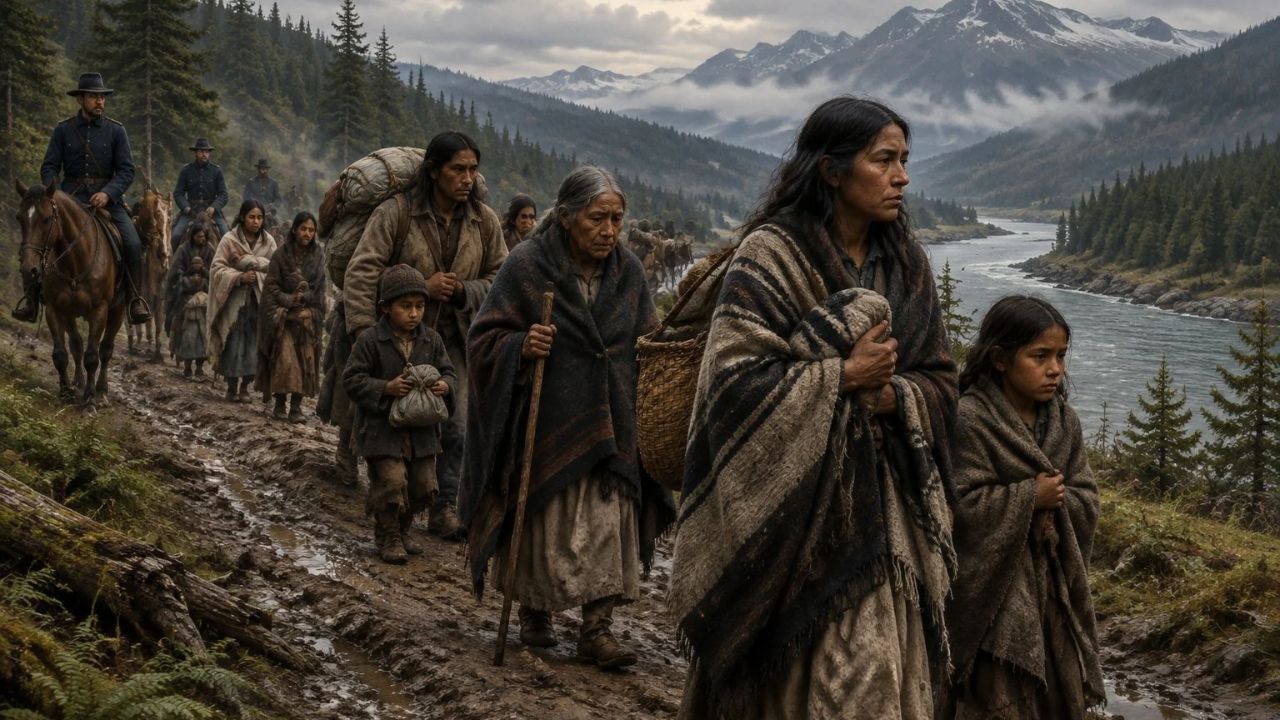
Between February 23 and March 25, 1856, federal troops and Indian agent George Ambrose forced several hundred Native people to walk from the Table Rock Reservation in the Rogue Valley to an encampment in the Coast Range foothills.
The Oregon Trail of Tears is the name descendants and historians give to this forced march of roughly 260 miles north to what became the Grand Ronde Reservation.
The name echoes the better-known Cherokee removal, but this event belongs to western Oregon.
The Grand Ronde removal of 1856 was one part of a wider campaign. Across the continent, federal removal policies dislocated diverse Native nations from their ancestral homelands.
In western Oregon, Umpqua, Kalapuya, Tututni, Chetco, and other peoples were moved to the Grand Ronde and Coast reservations. Readers can trace why the removal happened, how the march unfolded, and how the tribes survived and rebuilt.
Why Were the Table Rock Peoples Forcibly Removed?
The Table Rock peoples were removed because a broken 1853 treaty, settler massacres, and the final Rogue River War convinced federal officials they could not stay safely in the Rogue Valley.
Superintendent Joel Palmer chose distant reservations on the Coast Range, first the Coast Reservation and then a receiving camp at Grand Ronde.
The Collapse of the Table Rock Reservation
In September 1853, Joseph Lane and Superintendent Joel Palmer signed treaties with Rogue Valley leaders. Native leaders sold roughly two thousand square miles and accepted a reservation of about one hundred square miles north of the Rogue River.
The treaty did not bring safety. Confinement cut people off from seasonal gathering and hunting. Hunger, disease, and attacks followed, and people who left the reservation were often hunted down by militias.
On October 8, 1855, volunteers led by James Lupton attacked Native camps at dawn. That attack, the Lupton Massacre, opened the final Rogue River War.
Many families who refused to fight sought protection near Fort Lane, the Army post at the base of Table Rock.
Federal Removal Policy in Western Oregon
Palmer concluded that the Rogue Valley tribes would be killed if they stayed near settlers and miners. His answer was removal to reservations far from the gold fields and farms.
This approach mirrored earlier federal actions across the country. Decades prior, President Martin Van Buren directed General Winfield Scott to forcibly round up the Cherokee people after the controversial Treaty of New Echota.
Principal Chief John Ross and the Cherokee National Council vehemently opposed that fraudulent agreement ceding Cherokee land. Yet the Cherokee Nation was brutally expelled along the Trail of Tears to Indian Territory in present-day Oklahoma.
Today, the Trail of Tears National Historic Trail is preserved by the National Park Service as a registered national historic trail. In western Oregon, federal officials applied similar expulsion tactics to strip tribes of their homelands.
This was not a single event. Removals to the Table Rock and Umpqua reservations took place between 1853 and 1855, and secondary removals in 1856 pushed tribes to permanent reservations at Grand Ronde, the Coast, Warm Springs and Umatilla.
The Coast Reservation (Siletz)
President Franklin Pierce created the Coast Reservation by executive order on November 9, 1855. It ran along the coast between Cape Lookout and the Siltcoos River.
The Siletz Agency later became the center of this reservation. Most of the southwestern Oregon peoples captured during the war ended up there.
The Grand Ronde Encampment
Grand Ronde, in the Yamhill River valley, first served as a receiving encampment in 1856. Umpqua and Kalapuya peoples were also moved there early that year, before the Table Rock group arrived.
The reservation was formally established in 1857. That later date explains why some sources place the march in 1857. Grand Ronde’s tribal government lists a 60,000-acre reservation created in the Coast Range.
The March from Table Rock, February–March 1856
The march lasted roughly a month in winter and covered about 260 miles, with a military escort, wagons for the weak, and a steady threat from settlers. George Ambrose’s daily journal is the main written record of the route and its toll.
Departure from Table Rock
On February 23, 1856, Chief Toquahear and roughly 400 Takelma, Shasta and Upper Rogue Athabaskan people were forced to leave Fort Lane. Toquahear, whom settlers called Sam, led the bands that refused to join the fighting.
Counts vary. Some accounts estimate 325 people at departure. Others count roughly 400. The difference likely reflects who was counted and when.
Ambrose served as the agent in charge. U.S. soldiers guarded the column.
The Route North
The route ran over mountains and along rivers, north through the Umpqua country and the Willamette Valley. It roughly followed the path of today’s Interstate 5 before turning west into the Coast Range.
Other bands joined as the column passed their homelands. The group reached the Grand Ronde camp on March 25, 1856, after about 33 days.
| Detail | Figure |
|---|---|
| Departure | February 23, 1856 |
| Arrival | March 25, 1856 |
| Length of travel | About 33 days |
| Distance | Roughly 260 miles |
| Recorded deaths | An estimated 8 |
| Recorded births | An estimated 8 |
Hardship on the Trail
Winter shaped every day of the march. Cold rain, deep mud, and swollen rivers slowed travel. Wagons carried elderly and sick people who could not walk.
Illness and exhaustion spread through the column. Militiamen followed the group, and Ambrose worked to stop them from attacking. He arrested one man.
Ambrose’s journal records 8 deaths and 8 births during the march. Tribal historians treat these as a minimum. Lt. E.O.C. Ord, who watched one 1856 removal, wrote: “It almost makes me shed tears to listen to them as they totter along.”
Arrival and Life at Grand Ronde
Grand Ronde gave the survivors no relief at first. Food, shelter, and supplies fell short; the Army controlled movement, and disease caused high death rates in the early years.
Conditions on Arrival
The Table Rock group arrived at a camp still being built. Housing was poor, and rations were thin. People who had lived by fishing, hunting, and gathering in the Rogue Valley now depended on government supplies that came late or not at all.
Fort Yamhill and Reservation Control
The Army built Fort Yamhill in 1856 at the edge of the reservation. Its job was to keep residents on the reservation and to keep settlers and Native people apart.
Lt. Philip Sheridan served at Fort Yamhill before his Civil War fame. The fort’s soldiers enforced the boundary in both directions.
Hunger, Disease and Restrictions on Leaving
Residents needed permission to leave. Those caught off the reservation could be forced back.
Crowding, poor food, and new diseases caused heavy losses in the first years. Fewer than two thousand survivors of the Rogue River War were counted on the reservations in 1857.
Many Tribes, One Reservation
More than two dozen tribes and bands came to live at Grand Ronde. They included Kalapuya, Umpqua, Molalla, Chinook, Takelma, Shasta and Rogue River Athabaskan peoples.
They spoke many languages. Chinuk Wawa, a regional trade language, became the shared tongue. At first, groups settled apart from each other. Over time, they formed one community.
Unfulfilled Treaty Promises
Treaties promised payments, goods, schools, tools, and services. Many of these came late, arrived short, or never came at all.
The government also shrank the land base. Grand Ronde fell from 61,000 acres to 11,500 today, while Siletz dropped from 1.1 million acres to nearly 17,000.
The Coastal and Lower Rogue Removals to Siletz
The Rogue River peoples who fought on were removed in the summer of 1856, mostly to the Coast Reservation. These removals were separate from the Table Rock march, which had ended months earlier.
The End of the Rogue River War
The war turned in late May 1856 at the Battle of Big Bend on the lower Rogue. Some bands had agreed to surrender to Capt. Andrew J. Smith.
On May 27, followers of Tecumtum, known as Chief John, attacked Smith’s troops. Fighting lasted until reinforcements arrived the next day.
Most bands surrendered in June. Tecumtum surrendered in late June. An estimated 235 to 267 Native people died in the war, along with 50 soldiers and roughly 44 settlers.
Removal by Ship and by Land
Most survivors were sent by steamship from Port Orford to Portland, then on to Grand Ronde. Tecumtum’s band and two south coast bands walked north along the coast.
Many of these people were later moved to the mouth of the Salmon River and then to the Siletz Agency. Chetco, Tututni, and other coastal peoples were among them.
Historian Stephen Dow Beckham noted that similar forced marches hit the Umpqua and Willamette valleys, along with bands moved from Port Orford to Siletz.
Tribal Survival, Restoration and Remembrance
The tribes removed in 1856 survived federal termination, won back recognition, and now lead cultural renewal. Siletz regained federal status in 1977 and Grand Ronde in 1983.
Termination and Restoration
The Western Oregon Indian Termination Act of 1954 ended federal recognition of more than 60 western Oregon tribes and bands. Grand Ronde and Siletz lost their reservation lands and federal services.
Tribal members fought for years to undo this. Congress restored the Confederated Tribes of Siletz Indians in 1977. The Confederated Tribes of the Grand Ronde Community won restoration in 1983 and later regained part of its reservation.
The Confederated Tribes Today
Both nations run their own governments, health programs, schools, and businesses. Grand Ronde’s Chachalu Museum and Cultural Center keeps tribal history. Language programs teach Chinuk Wawa to children and adults.
The tribes have also returned to the Rogue Valley. Grand Ronde and Siletz members gather acorns at Acorn Camp near the Table Rocks. Siletz hosts Run to the Rogue, a 216-mile relay along the coast and up the river.
Commemorating the March and Teaching Its History
A roughly 26-foot western redcedar pole stands outside the achaf-hammi plankhouse at the Uyxat Powwow Grounds. It marks the end of the Trail of Tears. Carved faces on the pole stand for five treaties, each shedding tears.
Oregon’s Tribal History/Shared History curriculum brings the march into public schools. Lessons draw on Ambrose’s diary, which Beckham edited.
Photographer Nolan Streitberger’s Oregon’s Trail of Tears project, shown at Benton County Museums, adds another way to see the route.
Streitberger documented historical landscapes along the path using wet plate collodion tintypes to evoke the mid-nineteenth-century era.
Frequently Asked Questions
What is Oregon’s Trail of Tears?
It is the forced march of Rogue Valley peoples from the Table Rock Reservation to Grand Ronde in early 1856. Descendants and historians use the name to link it to other U.S. removals.
Some also use it for the wider 1856 removals in western Oregon.
When did the removal to Grand Ronde happen?
The march began February 23, 1856, and ended March 25, 1856. Grand Ronde was formally made a reservation in 1857, which is why some accounts give that year.
How far did the Table Rock peoples have to walk?
They walked roughly 260 miles over about 33 days. The route crossed mountains and rivers in winter rain and mud.
Who led the removal to Grand Ronde?
Superintendent Joel Palmer set the removal policy and chose the distant reservations. Indian agent George Ambrose carried out the march with a U.S. Army escort and kept the daily journal.
Which tribes were removed to Grand Ronde?
The Table Rock march included Takelma, Shasta, and Upper Rogue Athabaskan peoples led by Toquahear. Umpqua, Kalapuya, and many other bands were also moved there, bringing the total to more than two dozen tribes and bands.
What happened to the tribes after removal?
They faced hunger, disease, and land loss, then termination in 1954. They won restoration and today keep strong ties to the Rogue Valley through gatherings, language work, and teaching.

Cory is a website owner and content creator who enjoys fishing, history, coin collecting, and sports, among other hobbies. He is a husband and father of four.
Romans 15:4 For whatever was written in former days was written for our instruction, that through endurance and through the encouragement of the Scriptures we might have hope.