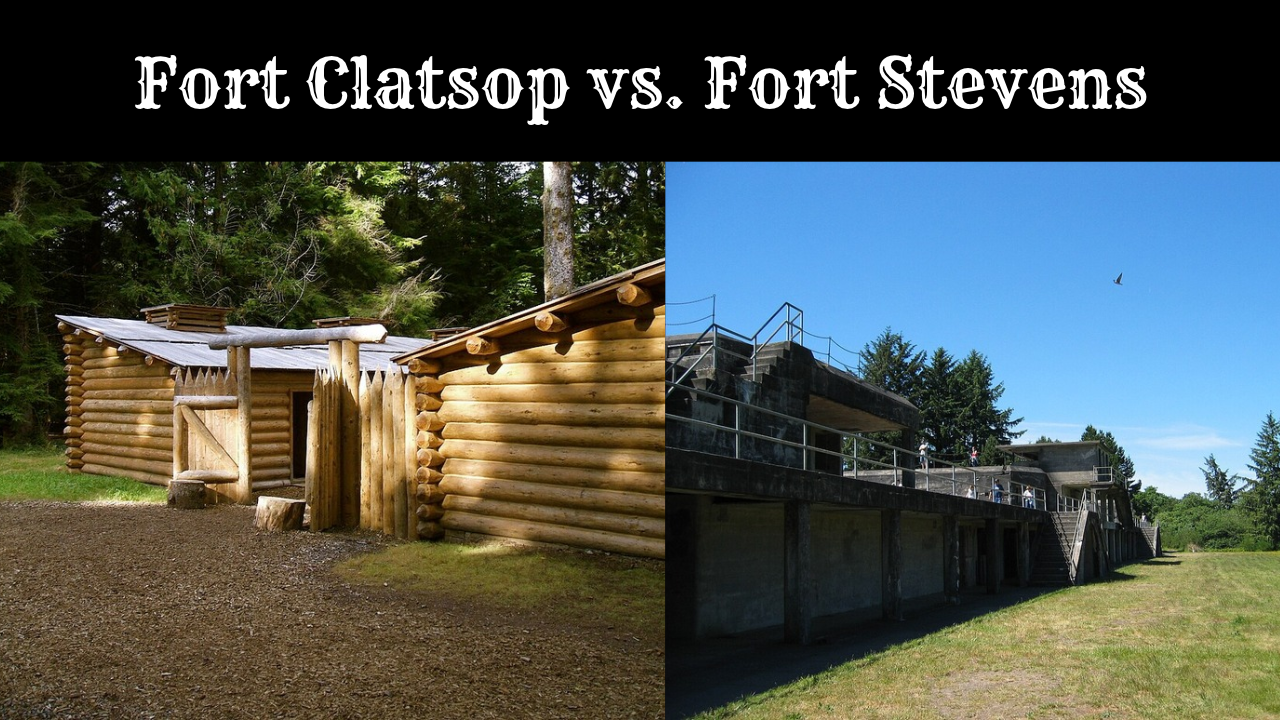
Nearby, fort clatsop vs. fort stevens shows both forts sit only a few miles apart in Clatsop County, Oregon, near the mouth of the Columbia River.
Their names sound alike, but they tell very different parts of the Pacific Northwest and its rich history.
Fort Clatsop is a replica of the small log camp where the Lewis and Clark Expedition spent the winter of 1805-1806, while Fort Stevens is a former military fort that guarded the Columbia River from the Civil War to World War II.
Originally designated as Fort Clatsop National Memorial, the site is now part of Lewis and Clark National Historical Park. Both sites are recognized on the National Register of Historic Places.
Fort Stevens is now a 4,300-acre state park with camping, beaches, trails, and a historic shipwreck.
When deciding between Fort Clatsop vs. Fort Stevens, travelers often wonder which site fits their trip best.
This guide compares the history, activities, and visitor experience at each fort along the Pacific Coast to help travelers plan their visit.
BOOK YOUR TRIP TO ASTORIA, OREGON HERE
At-a-Glance Comparison (Comparison Table)
Fort Clatsop and Fort Stevens are both near Astoria, Oregon. They cover very different parts of history. The table below shows how they compare.
| Feature | Fort Clatsop | Fort Stevens |
|---|---|---|
| Time period | Winter of 1805–1806 | Civil War (1860s) through World War II |
| Original purpose | Winter camp for the Lewis and Clark Expedition | Military fort guarding the Columbia River mouth |
| Managed by | National Park Service | Oregon Parks and Recreation Department |
| Park name | Lewis and Clark National Historical Park | Fort Stevens State Park |
| Location | About 15 minutes south of Astoria | Near Hammond, west of Astoria |
| Main structure | Replica wooden fort, rebuilt in 2006 | Original concrete gun batteries and buildings |
| Size of fort | About 50 by 50 feet | Large park with beaches, lakes, and trails |
| Camping | No | Yes, a large campground |
| Hours | 9 AM–6 PM in summer, 9 AM–5 PM off-season | Varies by area and season |
| Best for | Early exploration history and ranger talks | Military history, beaches, and outdoor activities |
Key Differences in Brief
- Fort Clatsop is a small, focused site. Visitors walk through a replica of the fort and can talk with costumed rangers.
- Fort Stevens is much larger. It includes the remains of the Peter Iredale shipwreck and the site where a Japanese submarine fired on the fort in 1942.
Fort Clatsop usually takes a few hours to see. Fort Stevens can fill a full day or a camping trip.
Fort Clatsop: Overview
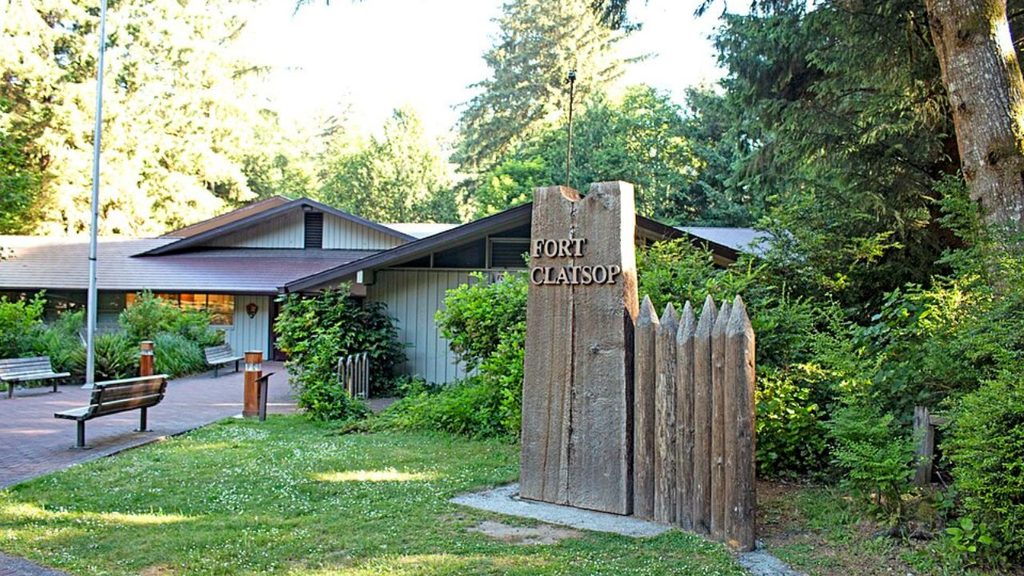
Fort Clatsop is the site where the Lewis and Clark Expedition spent the winter of 1805-1806, about 5 miles southwest of Astoria, Oregon.
Today, it features a full-size replica fort, a visitor center with a museum, and miles of forest trails inside Lewis and Clark National Historical Park.
History: The Corps of Discovery’s Winter Camp
Commissioned by President Thomas Jefferson, Meriwether Lewis and William Clark led the Corps of Discovery across the continent from St. Louis. The party reached the Pacific coast in late 1805.
Clark picked a site near the Lewis and Clark River because it had plenty of elk and sat close to the ocean. He sketched a simple plan, and construction began in early December.
The fort was finished by January 1, 1806. It held Meriwether Lewis, William Clark, 31 other men, French interpreter Toussaint Charbonneau, his wife Sacajawea, their baby Jean Baptiste, and a dog named Seaman.
The leaders named the post after the local Clatsop Indians. Members of the Clatsop Nation and their leader Coboway allowed the group to build there, and his people frequently traded food and goods with the expedition.
The expedition also interacted with the nearby Chinook and Tillamook communities living along the rugged Pacific Coast.
The winter was very rainy. The crew spent it on these tasks:
- Hunting elk and making leather clothing
- Boiling seawater to make salt
- Trading with neighboring Tillamook and coastal bands
- Updating maps and journals
The expedition left on March 23, 1806, and the original fort slowly fell apart.
What You’ll See: Replica Fort, Visitor Center and Trails
The first replica was built in 1955 from Clark’s sketch. It burned down in 2005. A second replica opened in 2006 in the same spot. Clark described the fort as about 50 feet square, with two rows of cabins facing each other.
Visitors can walk through the small rooms and talk with rangers in period clothing. During busy seasons, rangers lead programs that show daily life at the fort.
The visitor center includes:
| Feature | Details |
|---|---|
| Museum | Exhibits on the expedition and the Clatsop people |
| Films | Two short films |
| Bookstore | Books, maps, and gifts |
| Ranger desk | Maps, park fees, and trail tips |
The fort sits in a forest of tall Sitka spruce. It also serves as a trailhead for long-distance hikers.
The Fort to Sea Trail runs about 6.5 miles one way across the Clatsop Plains to the Pacific Ocean, linking to regional paths like the Oregon Coast Trail.
Best for Fort Clatsop Visitors
Fort Clatsop works well for people who want to learn about the Lewis and Clark Expedition in a hands-on way. It suits families, school groups, and history fans who like to see how people lived.
It is also a good choice for hikers. The trails offer short walks near the fort and longer hikes through the forest.
Plan around these hours:
- Mid-June to Labor Day: 9 AM to 6 PM
- Rest of the year: 9 AM to 5 PM
Bring a rain jacket for most of the year, since the area gets heavy rain.
Most visitors spend 2 to 3 hours at the site, or longer if they hike. The park is about 15 minutes south of Astoria, so it fits easily into a day trip along the Oregon coast.
Fort Stevens: Overview

Fort Stevens served as a U.S. Army post at the mouth of the Columbia River from 1863 to 1947.
Today it sits inside Fort Stevens State Park, where visitors can explore concrete gun batteries, a military museum, and the wreck of the Peter Iredale on the beach.
History: Guarding the Mouth of the Columbia
Congress approved forts to defend the Columbia River in 1862 during the American Civil War.
Soldiers built Fort Stevens in 1863–64 as an earthwork battery at Point Adams, near present-day Hammond, Oregon. It was first called the Fort at Point Adams.
Set along the northern edge of Clatsop Spit, the Fort at Point Adams stood opposite Fort Canby on Cape Disappointment.
In 1865, the Army renamed it for Isaac I. Stevens. He was the first governor of Washington Territory, had previously served across the wider Oregon Territory, and died at the Battle of Chantilly in 1862.
The post was constructed as the southern anchor of a three-fort harbor defense system safeguarding the Columbia River.
The fort was upgraded several times over the decades:
- 1890s to early 1900s: New concrete gun batteries, barracks, and mine depots built during Endicott Board modernizations and the Alaska boundary dispute period
- World War I and II: More soldiers and vital coastal defense duties
- June 21–22, 1942: Japanese submarine I-25 fired 17 shells at the fort, but caused almost no damage
The Army closed the fort in 1947. The land later became part of the state park.
What You’ll See: Batteries, Earthworks, Museum and the Peter Iredale Shipwreck
The park has many structures from different time periods. Most sites are close together in the Fort Stevens Historic Area.
| Site | What It Is |
|---|---|
| Battery Russell | Concrete gun battery near the 1942 shelling site |
| Civil War earthwork | Remains of the original dirt fort |
| Other batteries | Battery Mishler, Battery Pratt, Battery 245, and more |
| Military museum | Uniforms, weapons, photos, and maps |
| Peter Iredale | Shipwreck on the beach |
Visitors can walk through the empty batteries, including World War II-era Battery 245, and read signs that explain how the guns worked. Seasonal guided tours are offered at times, and their schedules can change.
The Peter Iredale was a four-masted steel sailing ship. It ran aground along Clatsop Spit in October 1906, and its rusted frame still sits on the sand. It is easiest to see at low tide.
Best for Fort Stevens Visitors
Fort Stevens works well for visitors who want history and outdoor time in one place. The park covers about 4,300 acres and is part of the Lewis and Clark National Historical Park.
It is a good fit for:
- Military history fans who want to explore batteries from the Civil War to World War II
- Families and campers, since the park has one of the largest campgrounds in Oregon, with tent sites, RV sites, yurts, and deluxe cabins
- Bikers and hikers, who can use miles of paved paths and trails
- Beach visitors who want to see the shipwreck or the South Jetty
Plan for a half day to see the main sites. A full day or overnight stay allows time for the beach, trails, and Coffenbury Lake. A day-use parking permit is needed for vehicles.
BOOK YOUR TRIP TO ASTORIA, OREGON HERE
Key Differences
A closer look at Fort Clatsop vs. Fort Stevens highlights distinct chapters of the Pacific Coast story.
Fort Clatsop reflects the homelands of the Clatsop Nation and the winter of 1805–1806, while Fort Stevens covers more than 80 years of military history from the Civil War to World War II.
The two sites also differ in what is original, how large they are, what they cost, and how long a visit takes.
Historical Era
Fort Clatsop dates to the Lewis and Clark Expedition. Sent by Thomas Jefferson from St. Louis, Meriwether Lewis and William Clark built the post in December 1805 as a winter camp near the Clatsop Indians.
Decades before settlers arrived via the Oregon Trail, the expedition documented the lands of the Pacific Northwest. Fort Clatsop was later commemorated as the Fort Clatsop National Memorial and added to the National Register of Historic Places.
Fort Stevens comes from a later era. The U.S. Army built it during the American Civil War to guard the mouth of the Columbia River from Confederate raiders or foreign navies.
Fort Stevens saw continued improvements through border tensions like the Alaska boundary dispute, serving actively until the end of World War II.
Fort Stevens stayed in use through World War II. In June 1942, a Japanese submarine fired shells near the fort. The Army closed the fort in 1947.
| Feature | Fort Clatsop | Fort Stevens |
|---|---|---|
| Time period | 1805–1806 | 1860s–1947 |
| Main purpose | Winter shelter | Coastal defense |
| Key story | Exploration | Military history |
Original Structures vs. Replica
The fort at Fort Clatsop is a replica. Nothing remains of the 1805 log buildings. Local people built a copy in 1955 based on Clark’s notes and sketches. That copy burned in 2005, and a new one opened in 2006.
Visitors can walk through the small rooms and touch the wood walls. In summer, rangers in period clothing often show skills like fire starting and candle making.
Fort Stevens has many original structures. Visitors can see:
- Concrete gun batteries, such as Battery Russell
- Earthwork walls from the Civil War era
- Old military buildings and a museum
The park also has a replica Clatsop plank house and the wreck of the Peter Iredale, a ship that ran aground in 1906.
Size and Recreation
Fort Clatsop is part of Lewis and Clark National Historical Park. The fort area is small. It includes a visitor center, the replica fort, and short trails. The Fort to Sea Trail runs about 6.5 miles one way to Sunset Beach.
Fort Stevens State Park covers about 3,700 acres. It is one of the largest campgrounds in Oregon, with hundreds of tent, RV, cabin, and yurt sites.
Recreation at Fort Stevens includes:
- Paved bike paths and hiking trails
- Beach walking and fishing
- Swimming and boating at Coffenbury Lake
- Wildlife viewing at the South Jetty
Fort Clatsop focuses on history. Fort Stevens mixes history with outdoor activities.
Cost and Passes
Fort Clatsop is run by the National Park Service. It charges an entrance fee for visitors age 16 and older. Children 15 and under enter free. The America the Beautiful pass covers entry.
Fort Stevens is run by Oregon State Parks. It charges a day-use parking fee per vehicle, not per person. An Oregon State Parks annual parking permit covers this fee. Campers do not pay a separate day-use fee while staying at the park.
| Site | Fee type | Pass accepted |
|---|---|---|
| Fort Clatsop | Per person (16+) | America the Beautiful |
| Fort Stevens | Per vehicle | Oregon State Parks permit |
The National Park pass does not work at Fort Stevens. Fees can change, so visitors should check each agency’s website before a trip.
Time Needed
Most visitors spend 1 to 2 hours at Fort Clatsop. This is enough time to watch the film, see the exhibits, and tour the replica fort. Walking a short trail adds about 30 minutes. Hiking the full Fort to Sea Trail takes most of a day.
Fort Stevens needs more time. A quick stop at the shipwreck and one battery takes 2 to 3 hours. Seeing the museum, batteries, beach, and jetty can fill a full day.
Many visitors camp at Fort Stevens for 2 or more nights. The two sites are only about 15 minutes apart by car, so both fit easily into one trip.
Which Fort Should You Visit?
The choice between Fort Clatsop or Fort Stevens depends on a visitor’s interests and time. In the Fort Clatsop vs. Fort Stevens decision, your preferred activities matter most. Both sites sit near Astoria, so many travelers see both in one day.
| Factor | Fort Clatsop | Fort Stevens |
|---|---|---|
| Main focus | Lewis and Clark Expedition (1805–1806) | Military history (Civil War to World War II) |
| Size | Small replica fort and trails | 4,300-acre state park |
| Time needed | 1–2 hours | Half a day or more |
| Cost | $10 per adult, free for ages 15 and under | Day-use parking fee |
| Best for | History fans and families with kids | Outdoor fans, campers, and beachgoers |
Is Fort Clatsop worth visiting? For people interested in early American exploration, the answer is usually yes. The replica shows how 33 people lived through a wet winter in a 50-by-50-foot fort.
In peak season, rangers show skills like flintlock shooting and candle making. Kids can also earn a free Junior Ranger badge.
Fort Stevens suits visitors who want more space and variety. The park offers:
- A Civil War-era earthen fort
- Concrete gun batteries to explore
- A military museum
- The Peter Iredale shipwreck on the beach
- Camping, biking, and hiking trails
Travelers with limited time often pick Fort Clatsop for a short, focused stop. Those planning a longer stay tend to choose Fort Stevens.
How to Visit Both Forts in One Day (Sample Itinerary)
Seeing Fort Clatsop and Fort Stevens in one day is simple to plan. The two sites sit near Warrenton, Oregon, about 10 miles apart. The drive between them takes roughly 15 to 20 minutes.
Most visitors start at Fort Clatsop in the morning. The site is smaller, and it is often less busy early in the day. Fort Stevens covers a much larger area, so it works well for the afternoon.
| Time | Stop | Activities |
|---|---|---|
| 9:00 a.m. | Fort Clatsop Visitor Center | Watch the film and view the exhibits |
| 10:00 a.m. | Fort Clatsop replica | Tour the fort and see ranger demonstrations (peak season) |
| 11:00 a.m. | Canoe landing and trails | Take a short walk near the river |
| 12:30 p.m. | Astoria or Warrenton | Stop for lunch |
| 2:00 p.m. | Fort Stevens historic area | Explore the old military batteries |
| 3:30 p.m. | Peter Iredale shipwreck | Walk the beach near the wreck |
| 4:30 p.m. | Coffenbury Lake or South Jetty | Relax or view the Columbia River mouth |
Helpful tips for the day:
- Check hours first. Hours change by season, so visitors should review the park websites before leaving.
- Bring rain gear. The area gets about 70 inches of rain each year.
- Plan for fees. Each site may charge its own entry or parking fee.
- Wear good shoes. Both forts include trails, grass, and sandy ground.
Families with children can ask for the free Junior Ranger book at Fort Clatsop.
Tips for Visiting Both Sites
Fort Clatsop and Fort Stevens are close to each other near Warrenton, Oregon. The drive between them takes about 20 minutes. Many visitors see both sites in one day.
Plan your timing. Fort Clatsop is open from 9 a.m. to 5 p.m. daily. It is busiest between 11 a.m. and 3 p.m., so visitors often go there first in the morning. They can then spend the afternoon exploring Fort Stevens.
Know the fees. Each site has its own entry rules.
| Site | Managed By | Pass Notes |
|---|---|---|
| Fort Clatsop | National Park Service | National park passes are accepted |
| Fort Stevens | Oregon State Parks | Requires an Oregon state park day-use permit |
A national park pass does not cover the parking fee at Fort Stevens. Visitors should check current prices before they go.
Prepare for the trip.
- Download maps ahead of time. Cell service is limited for some carriers. The NPS App lets users save park information for offline use.
- Pack rain gear. The north Oregon Coast is often wet and cool, even in summer.
- Bring pets on a leash. Leashed pets are allowed on trails at both sites.
- Wear good walking shoes. Both parks have trails, and Fort Stevens covers a large area.
Book lodging early. Fort Clatsop has no campground. Fort Stevens has a large campground, but it often fills up in summer. Local hotels in Astoria and Warrenton also book quickly during late July and early August.
Other Nearby Historic Sites
Fort Clatsop and Fort Stevens are not the only historic places in the area. Astoria and the nearby coast have many sites that are easy to add to a trip. Most are within a 30-minute drive.
| Site | Location | What Visitors Can See |
|---|---|---|
| Fort Astoria | Downtown Astoria | A small site marking a 1811 fur trading post |
| Astoria Column | Coxcomb Hill, Astoria | A 125-foot tower with 164 steps and wide views |
| Peter Iredale Shipwreck | Fort Stevens State Park | Remains of a ship that ran aground in 1906 |
| Salt Works | Seaside | A rebuilt site where Lewis and Clark’s group made salt |
| Fort Columbia | Chinook, Washington | Old coastal defense buildings across the river |
Historic Forts Near Astoria
Fort Astoria was one of the first American settlements on the West Coast, founded in 1811 by John Jacob Astor’s Pacific Fur Company. John Jacob Astor aimed to build a global trade post connecting the Pacific Coast with Asian markets. During the War of 1812, British forces took control of the post and renamed it Fort George.
The Hudson’s Bay Company later ran operations from the outpost before regional trading hubs shifted upriver. It later returned to American possession, paving the way for overland pioneers arriving along the Oregon Trail. Today, a marker and a rebuilt blockhouse show where it stood.
Across the Columbia River, Fort Columbia near Chinook and Fort Canby at Cape Disappointment were part of the same harbor defense system as Fort Stevens. Fort Canby guarded the north headland, while Fort Stevens secured Clatsop Spit. Together, these forts guarded the river’s mouth.
Things to Do Near Astoria, Oregon
- Columbia River Maritime Museum: Exhibits on ships, the river bar, and the Coast Guard
- Dismal Nitch: A Washington rest stop where Lewis and Clark’s group was stuck by storms for six days
- Netul Landing: A spot for picnics and kayak launches near Fort Clatsop
Many visitors pair these stops with a fort visit. This gives a fuller picture of the area’s past.
Where to Stay Near Astoria
Both forts sit close to Astoria, so travelers can visit each one from a single home base. Fort Clatsop is about 5 miles southwest of downtown Astoria. Fort Stevens is about 10 miles west, near the small town of Hammond.
Tripadvisor lists more than 50 hotels near each site. Options include hotels, vacation rentals, and campsites.
| Area | Type of Lodging | Best For |
|---|---|---|
| Downtown Astoria | Historic hotels, inns, B&Bs | Walking to shops, restaurants, and the riverfront |
| Warrenton | Chain hotels and motels | Lower prices and quick access to both forts |
| Hammond | Vacation homes and small rentals | Staying close to Fort Stevens |
| Fort Stevens State Park | Tent sites, RV sites, deluxe cabins, yurts | Campers and families |
| Seaside | Beach hotels and condos | Travelers who want ocean views |
Astoria has the most choices. Many hotels sit along the Columbia River, and some are in restored older buildings.
Warrenton sits between the two forts. It is a practical choice for visitors who plan to see both in one trip.
Fort Stevens State Park runs one of the largest campgrounds in the Oregon state park system. It offers hundreds of sites, plus yurts and cabins. Reservations often fill up early in summer.
Vacation rentals are common in the area. Sites like Airbnb and Vrbo list homes, condos, and cabins near Fort Stevens. These can work well for groups or longer stays.
Summer is the busiest season. Booking a few weeks ahead helps visitors get better rates and more choices.
Frequently Asked Questions
Fort Clatsop tells the story of the Lewis and Clark Expedition’s winter of 1805–1806, while Fort Stevens covers more than 80 years of U.S. military history from 1863 to 1947.
The two sites sit about 10 miles apart, have different fees and hours, and only Fort Stevens offers camping.
Which is better to visit, Fort Clatsop or Fort Stevens?
When weighing Fort Clatsop vs. Fort Stevens, neither site is better in every way. The right choice depends on what a visitor wants to learn and do.
Fort Clatsop is a good fit for people interested in early exploration, Native American history, and short forest walks. It is smaller and can be seen in two to three hours.
Many people ask, “Is Fort Stevens worth visiting?” For travelers who enjoy military history, beaches, biking, and camping, the answer is usually yes. The park covers a large area and can fill a full day or a weekend.
What are the main differences between the history of Fort Clatsop and Fort Stevens?
The two forts come from very different times and served different purposes.
| Feature | Fort Clatsop | Fort Stevens |
|---|---|---|
| Time period | Winter of 1805–1806 | 1863–1947 |
| Purpose | Winter camp for the Lewis and Clark Expedition | Army post guarding the mouth of the Columbia River |
| Who was there | 33 people and one dog, Seaman | U.S. Army soldiers |
| Original structures | None remain; the fort rotted away | Concrete gun batteries and other ruins remain |
| Key event | Expedition waited out the rainy winter | Shelled by Japanese submarine I-25 on June 21, 1942 |
Fort Clatsop was named after the Clatsop Indians, who helped the expedition through a cold, rainy winter on the Clatsop Plains.
The Clatsop Nation, along with neighboring Chinook and Tillamook tribes, maintained active trade networks along the Pacific Coast.
Their leader Coboway granted permission to build, while Toussaint Charbonneau and Sacajawea assisted the party in daily camp life.
Fort Stevens originated during the American Civil War as the Fort at Point Adams. It was later named for Isaac I. Stevens, a Union general and former governor of Washington Territory.
Operating alongside Fort Canby, it guarded the entrance to the Columbia River across three major wars before closing in 1947.
How far apart are Fort Clatsop and Fort Stevens, and can you visit both in one day?
The two sites are about 10 miles apart. The drive usually takes around 20 minutes.
Fort Clatsop is about 5 miles southwest of Astoria. Fort Stevens is near the town of Hammond, close to Warrenton.
Visiting both in one day is possible. A common plan is to spend the morning at Fort Clatsop and the afternoon at Fort Stevens. Visitors who want to see the shipwreck, gun batteries, and museum at Fort Stevens should allow at least four hours there.
What museums and historic attractions can you explore at Fort Clatsop and Fort Stevens?
At Fort Clatsop:
- A visitor center with exhibits and a film about the expedition
- A replica of the fort, rebuilt in 2006 after the 1955 version burned in 2005
- Ranger programs and costumed demonstrations, mostly in summer
- The Netul River Trail and the Fort to Sea Trail
- Two free audio tours on the official NPS app
At Fort Stevens:
- A military museum with exhibits on the fort’s history
- Battery Russell and other concrete gun batteries
- Seasonal guided tours of the historic area
- The wreck of the Peter Iredale, a ship that ran aground on the beach in 1906
- Miles of paved bike paths and hiking trails
How do the entrance fees and opening hours compare at Fort Clatsop and Fort Stevens?
Fort Clatsop charges a per-person entrance fee for adults age 16 and older. Children under 16 enter free. National park passes, such as the America the Beautiful pass, are accepted.
Fort Clatsop is open year-round. Hours are generally 9 a.m. to 5 p.m. in winter and 9 a.m. to 6 p.m. in summer. It closes on Thanksgiving, Christmas Eve, and Christmas Day.
Fort Stevens charges a daily parking fee per vehicle instead of a per-person fee. Oregon State Parks passes cover this fee. The park is open year-round, but the museum and tours have shorter hours in the off-season.
Fees can change, so visitors should check the National Park Service and Oregon State Parks websites before a trip.
What camping options are available near Fort Clatsop and at Fort Stevens State Park?
Fort Clatsop does not allow camping or overnight stays. Visitors who want to camp nearby often stay at Fort Stevens.
Fort Stevens State Park has one of the largest campgrounds in Oregon. It offers:
- Full-hookup RV sites
- Electrical sites
- Tent sites
- Yurts and deluxe cabins
- Hiker and biker sites
- Restrooms with hot showers
The campground is open year-round. Summer weekends fill up fast, so reservations are recommended. They can be made through the Oregon State Parks reservation system.

Cory is a website owner and content creator who enjoys fishing, history, coin collecting, and sports, among other hobbies. He is a husband and father of four.
Romans 15:4 For whatever was written in former days was written for our instruction, that through endurance and through the encouragement of the Scriptures we might have hope.