
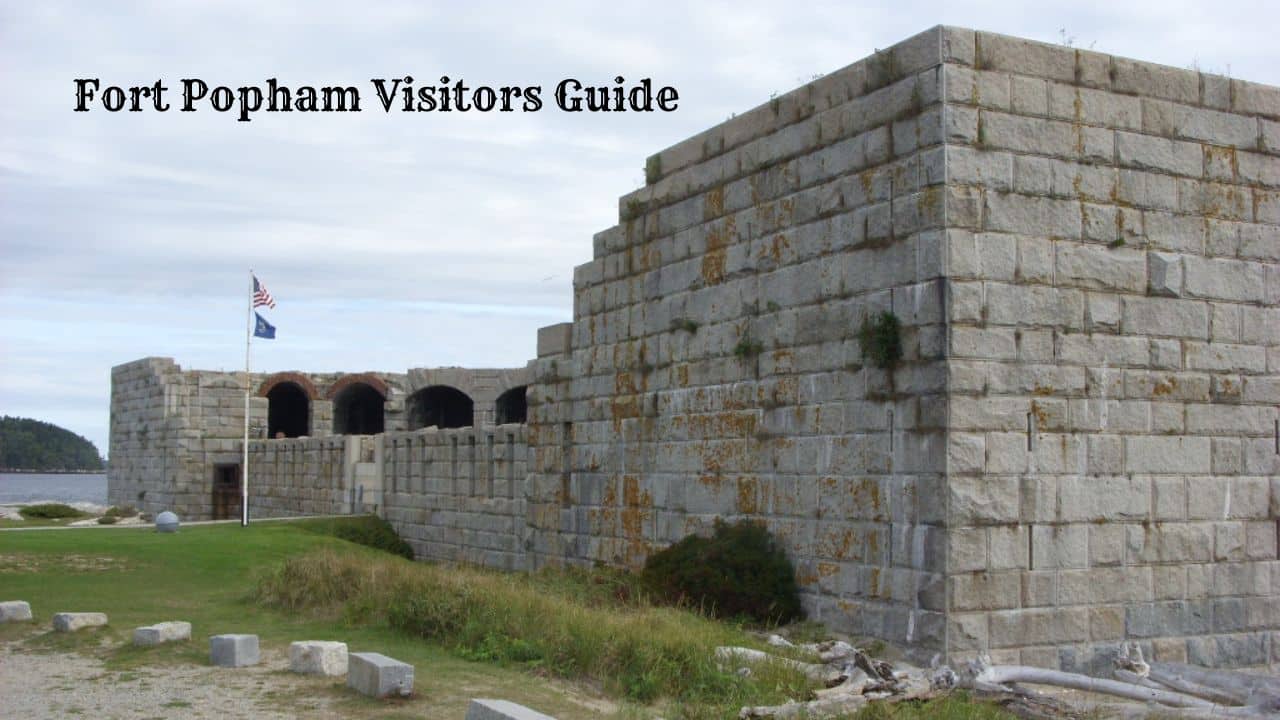
Fort Popham State Historic Site is a Civil War–era granite fort at the mouth of the Kennebec River in Phippsburg, Maine, and it is free to visit.
The 4-acre site in Sagadahoc County sits about 15 miles south of Bath and just two miles from Popham Beach State Park.
Construction started in 1861. The half-moon fort was built to guard the shipyards in Bath and the state capital in Augusta from a possible Confederate attack.
It was never fully finished, but the military used it again during the Spanish-American War and World War I.
Today, you can walk through the arched gun rooms, climb the granite stairways, and look out over the water where the Kennebec meets the Atlantic. The state bought the fort in 1924, and it joined the National Register of Historic Places in 1969.
This Fort Popham travel guide covers hours, parking, nearby beaches, fishing spots, and what to expect on a visit.
BOOK YOUR TRIP TO FORT POPHAM HERE
Fort Popham Visitor Information
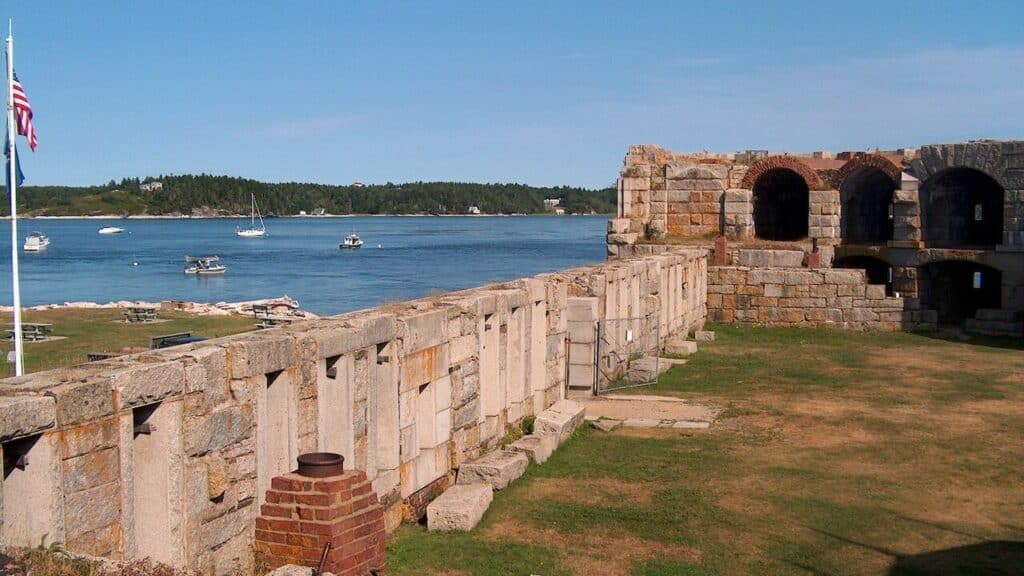
Fort Popham sits at the end of Route 209 in Phippsburg, Maine, right where the Kennebec River meets the Atlantic.
The granite fort is a state historic site managed by Maine’s Bureau of Parks and Lands.
Here are the basics:
| Detail | Information |
|---|---|
| Location | 10 Perkins Farm Lane, Phippsburg, ME (mouth of the Kennebec River) |
| Size | About 4 acres in Sagadahoc County |
| Admission | Free |
| Season | Typically open late May through September |
| Hours | Generally 9 a.m. to sunset during the open season |
| Parking | Roughly 25 spaces in the small lot |
The site is day-use only, so there’s no camping. Restrooms are seasonal, and you won’t find a visitor center or gift shop.
Parking is the biggest challenge here. On warm summer weekends, cars often line the road well before mid-morning, and the lot fills fast.
If you show up early — before 9 a.m. — you’ve got a much better shot at a spot. Weekdays and days in June or September are usually calmer.
Most people spend 30 minutes to an hour walking through the fort and reading the interpretive signs. Some stay longer to look out over the river and the ocean.
A few things worth knowing:
- Popham Beach State Park is about two miles away and charges a separate fee.
- The fort’s stone stairs and passages are uneven, so sturdy shoes help.
- Wheelchair access is limited to the ground level and outer areas.
BOOK YOUR TRIP TO FORT POPHAM HERE
The History of Fort Popham

The land at the mouth of the Kennebec River has been used for defense since the Revolutionary War, when a small fort stood on the site.
In 1808, the federal government built a battery here with six heavy guns and barracks for about 40 men.
It stayed in use until 1815 and saw minor action during the War of 1812.
Congress approved the current fort in 1857, but work didn’t start until 1861.
Builders used granite from nearby Fox and Dix Islands to create a crescent-shaped structure with walls 30 feet high.
The goal was to protect the shipbuilding city of Bath and the state capital in Augusta from Confederate ships.
Key dates:
| Year | Event |
|---|---|
| 1857 | Construction authorized |
| 1861 | Building begins |
| 1864–1865 | Garrisoned by the 7th Unassigned Company of Maine Infantry |
| 1869 | Work stops, fort never finished |
| 1924 | Maine purchases the fort from the federal government |
The fort was designed for 42 heavy guns across three tiers. Only two tiers were finished before construction ended in 1869, since rifled cannons had made stone forts easier to damage.
Soldiers returned during the Spanish-American War and World War I.
In the 1890s, the site gained facilities for a controlled minefield in the river.
Fort Baldwin, built on the hill above starting in 1905, carried longer-range guns and eventually made Fort Popham outdated.
What to See at Fort Popham
The fort’s curved granite walls, arched gun rooms, open parade ground, and river views make up the main attractions on this 4-acre site in Phippsburg, Maine.
Signs around the grounds explain how the fort was built and why it was placed here.
The Granite Fortifications
The fort is shaped like a half-moon, or crescent, facing the water. This curved design let defenders cover a wide stretch of the Kennebec River without leaving gaps.
Workers built the walls from large blocks of granite, cut and fitted with tight seams. The stone came from Maine quarries and was moved to the site by water.
Construction started in 1861, during the Civil War, and stopped in 1869. The fort was never finished, so you can spot unfinished sections where the third tier of walls just stops.
The walls stand about 30 feet tall and are roughly 20 to 30 feet thick in places. Up close, you can still see tool marks left by 19th-century stonecutters on many blocks.
Gun Emplacements and Casemates
The fort was designed to hold around 36 to 40 heavy guns, though it never carried a full set.
You can walk through the arched rooms, called casemates, where these guns would have sat.
Each casemate has a wide opening in the outer wall for the gun barrel, called an embrasure. Standing at one of these openings shows exactly what a gunner would have seen while aiming down the river.
Look for these details inside:
- Iron rail tracks set into the stone floors, which let crews pivot heavy cannons
- Vaulted brick and granite ceilings in each gun room
- Powder magazine spaces where ammunition was kept away from the guns
- Spiral granite staircases at each end of the fort leading to upper levels
Parade Ground and Interior
Behind the curved wall is the open parade ground, a grassy area where soldiers would have gathered and drilled. It’s flat, open, and easy to walk across.
From here, you get the clearest view of the fort’s full inner curve and the rows of arched openings stacked above each other.
The interior also includes remains of the officers’ quarters and support structures along the back of the fort.
Two circular stair towers connect the levels, and their spiral granite steps are among the most photographed parts of the site.
The top level is open in places, giving a look down onto the parade ground and out toward the water.
Kennebec River Views
The fort sits right where the Kennebec River meets the Atlantic Ocean. From the walls and the shoreline, you can watch boat traffic heading upriver toward Bath.
Several landmarks are visible from the site:
| Landmark | What It Is |
|---|---|
| Seguin Island Light | An 1857 lighthouse offshore, Maine’s tallest light tower |
| Pond Island | A small island with a light station at the river mouth |
| Popham Beach | A wide sand beach about 1.3 miles away by road |
| Fort Baldwin | A World War I-era fort on the hill, 0.6 miles by road |
The rocky shoreline next to the fort is a common spot for fishing and picnicking. Tides here move quickly, so footing on the wet rocks can be slick.
Historic Interpretive Features
Signs placed around the grounds explain the fort’s construction timeline, its role in protecting Bath’s shipyards, and why it never saw combat.
One panel covers the Popham Colony, an English settlement founded nearby in 1607. The fort is named for George Popham, who led that colony.
Other signs describe how gun technology changed during the 1860s. Rifled cannons made thick granite walls far less useful, which is a main reason the fort was left unfinished.
Parking is limited to about 25 spaces, and entry is free. Staff and volunteers are sometimes on site during summer months to answer questions.
Things to Do at Fort Popham State Historic Site
You can walk right into the granite fort and explore its arched rooms and stairways. The semicircular structure was built starting in 1861, and construction continued until 1869, though it was never fully finished.
Reading the interpretive signs takes about half an hour. The panels explain how the fort was designed to hold around 40 heavy guns and protect the Kennebec River route to Augusta, Maine’s capital.
Photography is a popular reason to stop here. The fort sits at the mouth of the river, so the stone walls, the water, and passing boats all make good subjects.
Other things people do at the site:
- Fish from the shoreline near the fort
- Watch boats and ships enter the Kennebec River
- Picnic on the grassy areas around the walls
- Look for seals, ospreys, and other coastal wildlife
The site also sits close to where the Popham Colony was founded in 1607. That short-lived English settlement adds another layer of history to the area.
Many people pair a fort visit with a stop at Popham Beach State Park, which is a short drive away.
Visiting Fort Popham at a glance:
| Detail | Information |
|---|---|
| Location | Phippsburg, Sagadahoc County, Maine |
| Size | About 4 acres |
| Admission | Free |
| Parking | Roughly 25 spaces |
Parking fills quickly in summer, especially on weekend mornings. Arriving early gives visitors a better chance at a spot.
Is Fort Popham Worth Visiting?
For most travelers, yeah, it’s worth a stop. Fort Popham doesn’t charge admission, sits right at the mouth of the Kennebec River, and you can wander through in about 30 to 60 minutes.
It’s the second most popular attraction in Phippsburg on Tripadvisor, with more than 170 reviews. Not too shabby for a little stone fort.
What visitors tend to like:
- Granite walls and arched gun rooms you can actually walk through
- Wide views of the river, the ocean, and boats drifting by
- Interpretive signs detailing its 1861–1869 construction and the 40 planned gun positions
- A grassy area and shoreline that are perfect for a picnic
- It’s just a short hop from Popham Beach State Park
What to keep in mind:
| Consideration | Detail |
|---|---|
| Parking | About 25 spaces, and they fill up fast on summer weekends |
| Traffic | Lines for beach parking can stretch over a mile by mid-morning |
| Bugs | Mosquitoes are common—bring bug spray |
| Facilities | Amenities are pretty limited on site |
| Time needed | Most people spend 30 minutes to an hour |
The fort works well for families with curious kids, for photographers, and for anyone who’s into Civil War-era coastal defense. It’s a smaller stop, not really an all-day thing.
People who want more time outside usually pair it with a few hours at Popham Beach. If you’re coming in July or August, try to arrive before 9:30 AM to dodge the worst of the parking crunch.
Tips for Visiting Fort Popham
Parking’s honestly the biggest headache here. Only about 25 spaces sit near the fort, and they’re usually gone early on summer weekends.
If you show up before 9 a.m., your odds of snagging a spot go way up.
What to wear and bring:
- Closed-toe shoes with good grip — those granite floors and stairs get uneven and damp
- Bug spray — mosquitoes love the water, especially at dusk
- A light jacket — that river wind can be chilly, even in July
- A picnic and water — you won’t find food for sale inside the fort
Most folks spend 30 minutes to an hour here. That’s enough to read the signs, wander the gun rooms, and snap a few photos of the river mouth.
| Detail | Information |
|---|---|
| Size | About 4 acres |
| Location | Phippsburg, Sagadahoc County |
| Admission | Free |
| Typical visit | 30–60 minutes |
Families with kids should watch their footing on the stairs and upper level. The stone steps are pretty narrow, and railings aren’t always there when you want them.
The fort’s a short drive from Popham Beach State Park, so lots of people combine both in one trip. Honestly, pairing them is smart if the beach parking lot fills up first.
Low tide opens up more shoreline by the fort for walking. It helps to check a tide chart before you head out.
Nearby Attractions
The fort sits at the end of a peninsula that’s loaded with places worth a quick stop. Most are just minutes away by car.
Popham Beach State Park is the big draw here. It’s got a long stretch of sand, tidal pools, and views of Fox Island and Wood Island Light.
If you want to walk out to Fox Island, check the tide chart—the sandbar vanishes at high tide, and you don’t want to get stranded.
Fort Baldwin State Historic Site is right up the hill behind Fort Popham. Built in the early 1900s and used through WWII, it’s got concrete gun batteries and an observation tower with wide river and ocean views.
Bates-Morse Mountain Conservation Area offers a quiet two-mile walk to Seawall Beach. Parking’s tight, so early arrival is your friend.
The Popham Colony site is nearby at Sabino Head. English settlers built a fort here in 1607—one of the earliest English settlements in New England.
Archaeologists confirmed the location in 1994. That’s a pretty cool bit of history tucked away in the pines.
For food, you’ll find a few local spots serving seafood near the beach:
| Spot | What to Expect |
|---|---|
| Spinney’s Restaurant | Sit-down meals with ocean views |
| Percy’s Store | Snacks, sandwiches, and basics |
| Local lobster shacks | Casual seafood, seasonal hours |
Bath is about 15 miles north. The town has the Maine Maritime Museum, some shops, and restaurants along the Kennebec River.
Frequently Asked Questions
People usually ask about the fort’s Civil War history, its free admission, and that tiny parking lot that fills up fast on summer weekends.
The answers below cover the basics—history, hours, directions, and the nearby beaches and hilltop fort.
What is the history of Fort Popham in Maine?
Fort Popham is a granite coastal fort at the mouth of the Kennebec River in Phippsburg, Maine. Construction started in 1861, during the Civil War, to guard the river and the shipbuilding city of Bath upstream.
The fort has a half-circle shape, thick granite walls, and two levels of arched gun rooms. It was supposed to hold about 40 big guns.
Work stopped in 1869, so the fort never got finished. The upper level was left incomplete, which is why the walls end unevenly at the top.
The fort got its name from George Popham, who led the Popham Colony in 1607. That English settlement stood nearby but only lasted about a year.
The site saw use again during the Spanish-American War and World War I. Now, the state preserves it as Fort Popham State Historic Site.
How much does it cost to visit Fort Popham?
It’s free. You can walk through the fort and read the signs without paying a cent.
Popham Beach State Park nearby does charge a day-use fee, so keep that in mind if you’re planning to hit the beach too.
What are the opening hours and seasonal access dates?
The site usually opens from late May through the end of September, 9 a.m. to sunset. Exact dates shift a bit each year.
The grounds are often accessible outside those dates, but the fort’s interior might be closed. It’s smart to check the Maine Bureau of Parks and Lands website before you drive out.
Are guided tours available at the fort?
There aren’t regular guided tours. Most people just explore on their own and read the signs posted around the grounds and inside.
Special events and occasional programs pop up, often run by local historical groups. If you really want a guided experience, try contacting the site or state parks office ahead of time.
How do I get there, and where can I park?
The fort sits at the end of Maine Route 209, about 15 miles south of Bath. The drive winds down the Phippsburg peninsula right to the water.
Parking is tight—about 25 cars fit, and it fills up quickly on warm summer days. Traffic on Route 209 can back up more than a mile in July and August, mostly because of beach traffic.
If you arrive before 9 a.m. or later in the afternoon, parking’s usually easier. Otherwise, you might be circling for a while.
What other attractions are nearby, including Popham Beach and Fort Baldwin?
Popham Beach State Park sits about two miles away. You’ll find a long stretch of sand, tidal flats, and views out to Fox Island and Wood Island Light there.
There’s a day-use fee, just so you know.
Fort Baldwin stands on the hill right behind Fort Popham. People built it in the early 1900s, and it still has those old concrete gun batteries.
You can reach the observation tower after a short walk up the trail. It’s not a tough hike, but the view from the top is honestly worth it.
The Popham Colony site is close as well, marked near the water. Bath, with the Maine Maritime Museum, sits about a 30-minute drive north—definitely doable if you’re up for a little road trip.

Cory is a website owner and content creator who enjoys fishing, history, coin collecting, and sports, among other hobbies. He is a husband and father of four.
Romans 15:4 For whatever was written in former days was written for our instruction, that through endurance and through the encouragement of the Scriptures we might have hope.